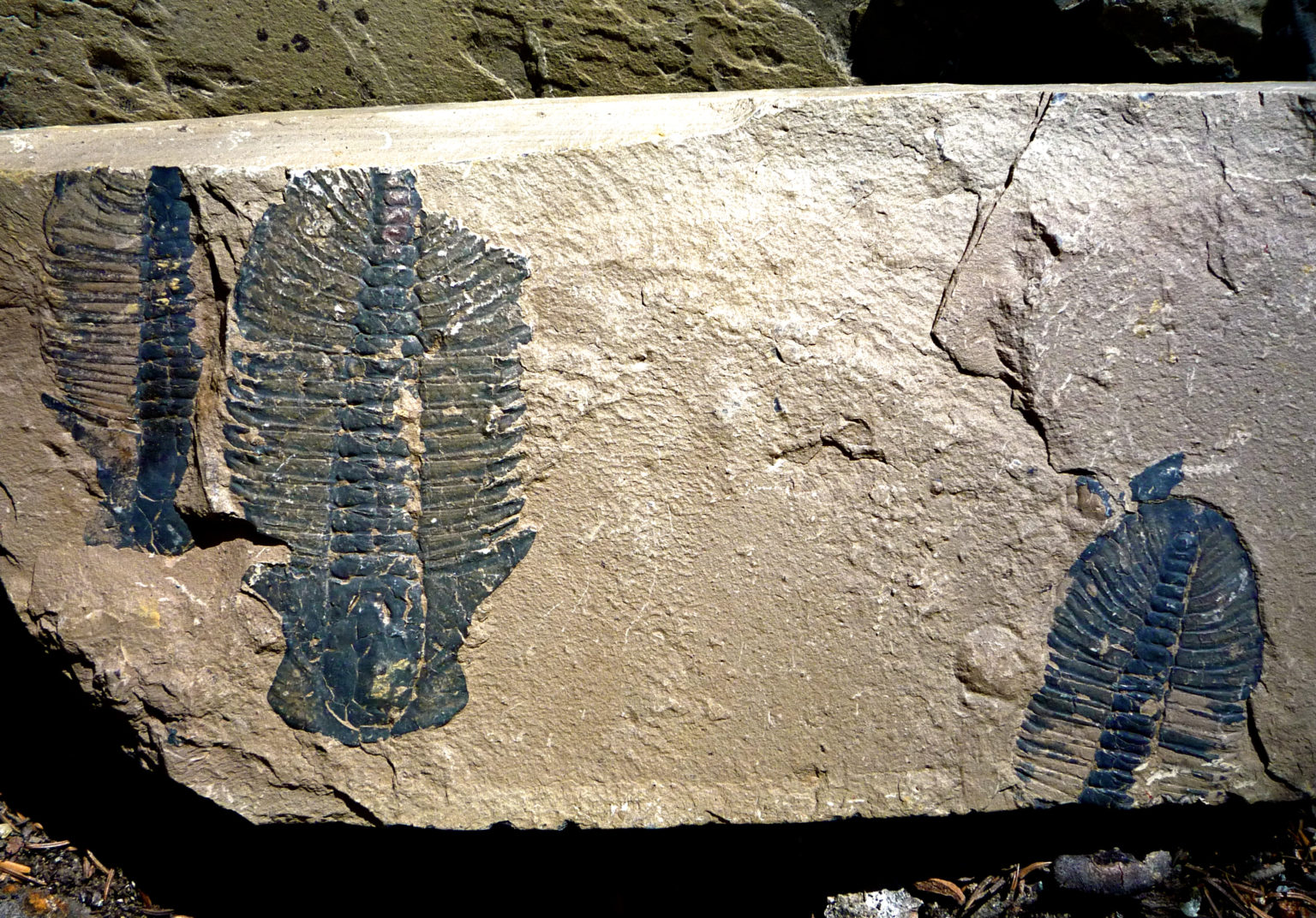

A period of 410,000 years seems like a long time for most people, but it’s relatively brief for scientists who study Earth’s history. Moreover, from a naturalistic perspective, this period of time would be considered implausibly brief for the required changes in the transition of life-forms from simple to complex. Several new research studies affirm the explosiveness of animal life in Earth’s history and carry implications for evolution and creation.
Life Exploded onto the Scene
The Cambrian explosion refers to the sudden, simultaneous appearance of the greatest number of phyla ever witnessed during the 3.8-billion-year history of Earth’s life. A phylum is a broad category of life-forms that share a common basic body plan. In eighteenth-century botanist Carl Linnaeus’s taxonomic classification system, a phylum ranks just below a kingdom in terms of inclusiveness.
Presently, there are a total of 30 phyla that comprise all Earth’s life. The Cambrian explosion, more than a half-billion years ago, saw the sudden appearance of all, or virtually all, these 30 phyla plus many more that became extinct. Estimates of the total number of phyla that appeared in the Cambrian explosion event range from 50 to 100.1 The new phyla that appeared in the Cambrian explosion (a largely marine event) included the first animals to possess skeletons, digestive tracts, circulatory systems, and complex internal and external organs. Not until the Cambrian explosion was there sufficient oxygen in Earth’s atmosphere and oceans for such animals to exist.
Animals that suddenly appeared at the beginning of the Cambrian period included the most advanced phyla in Earth’s history. We humans belong to the chordate phylum, which is characterized by animals that possess a dorsal hollow nerve cord and a notochord. All vertebrates and many invertebrates belong to the chordate phylum. Paleontologists have discovered fossils of chordates, including some vertebrates, that date back to the very beginning of the Cambrian period.
Dating the Cambrian Explosion
The textbook date for the Cambrian explosion is 543 million years ago. Recently, this date has been revised to 541 million years ago. While the fossil record establishes that many phyla suddenly and simultaneously arose at the beginning of the Cambrian period, determining an absolute date for this explosion of life has proved notoriously challenging.
Two of the best attempts to determine an absolute date for the Cambrian explosion were undertaken by research teams led by Diazhao Chen and Can Chen, respectively. Diazhao Chen and four colleagues obtained uranium-lead zircon ages from the Ediacaran-Cambrian boundary strata, where one stratum contains fossils of Ediacaran (the period prior to the Cambrian) animals and the immediately adjacent stratum contains fossils of Cambrian animals in the Liuchapo Formation in South China.
The fossil record reveals that the Ediacaran animals were the first to appear on Earth. Unlike the Cambrian animals, the Ediacaran fauna lacked digestive tracts, circulatory systems, skeletons, and complex organs. The record shows that the Ediacaran fauna experienced a sudden worldwide mass extinction event that was quickly followed by the appearance of the Cambrian explosion animals.
Diazhao Chen’s team determined a uranium-lead date of 542.1 ± 5.0 million years ago for the basal part of the Liuchapo Formation.2 For the mid-upper part of the Liuchapo Formation they measured a uranium-lead date of 542.6 ± 3.7 million years ago.3 Five years later, Can Chen and his colleague Qinglai Fena achieved a weighted mean uranium-lead zircon age of the lower part of the Liuchapo Formation and demonstrated that the lower part indeed reveals the Ediacaran-Cambrian boundary.4 The age of the boundary they produced was 540.7 ± 3.8 [±6.6] million years ago. The unbracketed error bar is the probable statistical error. The bracketed error bar is the probable systematic error.
Precision Date and Time Breadth of the Cambrian Explosion
In a third research effort, a team of 14 geochemists and geophysicists led by Ulf Linnemann discovered a way to obtain a precision date for the launch of the Cambrian explosion. They found a composite geological section in southern Namibia of the Ediacaran-Cambrian boundary that provided biostratigraphic and chemostratigraphic data that was bracketed by radiometric dating.5 Their measurements constrained the date for the Ediacaran-Cambrian boundary to no earlier than 538.99 ± 0.21 million years ago and no later than 538.58 ± 0.19 million years ago. Therefore, they concluded that the faunal transition from Ediacaran to Cambrian biota occurred within less than 410,000 years.6
The date for the Ediacaran-Cambrian boundary determined by Linnemann’s team is 2 million years younger than the dates measured by Diazhao Chen’s team and by Can Chen and Qinglai Feng. However, it is not discrepant. The three dates agree within the error bars of each of the three dates.
Another Phylum Discovered
In yet another study, researchers discovered evidence of a modern-day phylum that had not been found in Cambrian strata. Bryozoans, commonly known as moss animals, are soft-bodied aquatic invertebrate animals. The body sizes of these animals range from 0.1–1.0 millimeters. They possess tiny tentacles used for filter feeding.
Paleontologists once thought the origin of the bryozoa phylum occurred during the Tremadocian Stage (485–478 million years ago). However, an international team of ten geologists and biologists led by Zhiliang Zhang surmised that, given the soft- and small-bodied nature of bryozoa, fossils dating previous to 485 million years ago would be extraordinarily difficult to find. Zhang’s team made a diligent search in Cambrian strata in South China and Australia. In a recent issue of Nature, they reported discovering bryozoa fossils in early Cambrian strata in both Australia and South China.7 Thus, yet another phylum has been added to the list of known phyla that belong to the Cambrian explosion.
Philosophical Consequences
A time window for the Cambrian explosion briefer than 410,000 years is far too brief for any conceivable naturalistic model for the history of life. It would be far too brief even for the appearance of just one new phylum, let alone 30+ phyla. These discoveries make paleontologist Kevin Peterson’s conclusion in his review paper on the Cambrian explosion—published a dozen years ago—all the more compelling: “Elucidating the materialistic basis for the Cambrian explosion has become more elusive, not less, the more we know about the event itself.”8 The same goes for Gregory Wray’s review published in 1992, “The Cambrian ‘explosion’ of body plans is perhaps the single most striking feature of the metazoan fossil record. The rapidity with which phyla and classes appeared during the early Paleozoic, coupled with much lower rates of appearance of higher taxa since, poses an outstanding problem for macroevolution.”9
These advances pose no such problems for a creation model that describes a Creator’s intentional activity. Part of that intentionality includes packing the planet with a great diversity and abundance of animals that would help humans launch civilization.
Endnotes
- Roger Lewin, “A Lopsided Look at Evolution,” Science 241, no. 4863 (July 15, 1988): 291–293, doi:10.1126/science.241.4863.291.
- Diazhao Chen et al., “New U-Pb Zircon Ages of the Ediacaran-Cambrian Boundary Strata in South China,” Terra Nova 27, no. 1 (February 2015): 62–68, doi:10.1111/ter.12134.
- Diazhao Chen et al., “New U-Pb Zircon Ages.”
- Can Chen and Qinglai Feng, “Carbonate Carbon Isotope Chemostratigraphy and U-Pb Zircon Geochronology of the Liuchapo Formation in South China: Constraints on the Ediacaran-Cambrian Boundary in Deep-Water Sequences,” Palaeogeography, Palaeoclimatology, Palaeoecology 535 (December 2019): id. 109361, doi:10;.1016/j.palaeo.2019.109361.
- Ulf Linnemann et al., “New High-Resolution Age Data from the Ediacaran-Cambrian Boundary Indicate Rapid, Ecologically Driven Onset of the Cambrian Explosion,” Terra Nova 31, no. 1 (February 2019): 49–58, doi:10.1111/ter.12368.
- Linnemann et al., “New High-Resolution Age Data,” 49.
- Zhiliang Zhang et al., “Fossil Evidence Unveils an Early Cambrian Origin for Bryozoa,” Nature 599 (November 11, 2021): 251–255, doi:10.1038/s41586-021-04033-w.
- Kevin J. Peterson, Michael R. Dietrich, and Mark A. McPeek, “MicroRNAs and Metazoan Macroevolution: Insights into Canalization, Complexity, and the Cambrian Explosion,” BioEssays 31, no. 7 (July 2009): 737, doi:10.1002/bies.200900033.
- Gregory A. Wray, “Rates of Evolution in Developmental Processes,” American Zoologist 32, no. 1 (February 1992): 131, doi:10.1093/icb/32.1.123.